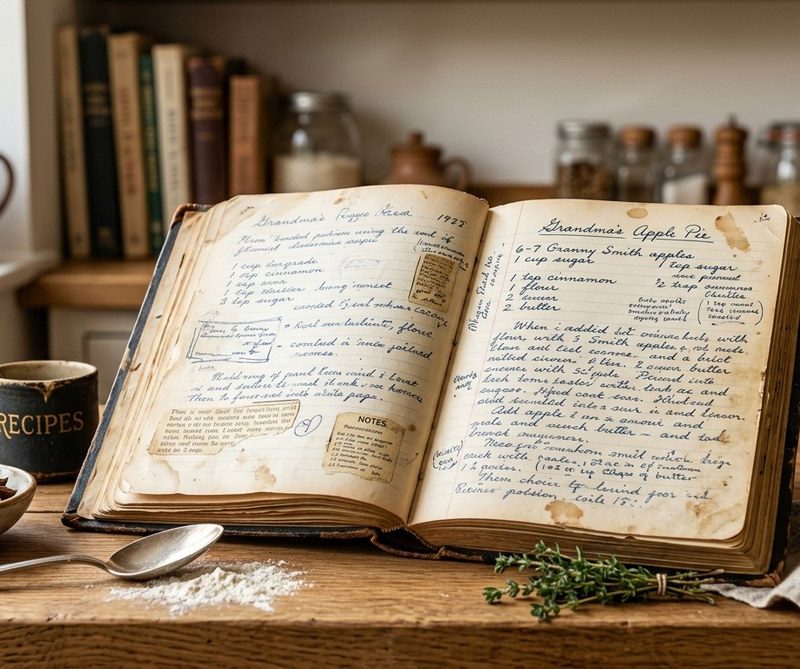
Your grandmother’s recipe book sits on a shelf, its spine cracked and pages stained with butter, flour, and what might be chocolate from a batch of brownies made thirty years ago. To someone outside the family, it looks like a simple collection of dishes. But to you, it holds the flavors of your childhood and the echoes of voices from generations past. This worn notebook is not just a cooking reference. It is a cultural artifact in the truest sense. It carries history, identity, and the story of how your family migrated, adapted, and survived. Every scribbled correction, every clipped newspaper recipe taped onto a page, every note that says “too much salt” or “add more vanilla” tells a story that no printed cookbook ever could.
A grandmother’s recipe book is more than a collection of ingredients. It is a handwritten archive of family history, cultural migration, and personal identity. These worn pages capture economic realities, holiday traditions, and the evolution of taste across generations. Each stain, margin note, and clipped newspaper clipping tells a unique story. Understanding how to read and preserve these artifacts helps us honor our heritage and keep culinary traditions alive for those who come after us.
The Handwritten Legacy: More Than Recipes
When we talk about cultural artifacts, we usually think of pottery, tools, or textiles displayed in museums. But the most intimate artifact of daily life often sits in a kitchen drawer. A grandmother’s recipe book is a primary source document. It records what people actually ate, not what cookbook authors thought they should eat.
These books are full of clues about the past. The ingredients reflect what was available locally and what the family could afford. The techniques reveal whether a household had access to modern appliances or relied on wood stoves. The handwriting changes over time, showing the effects of age or illness. Some pages are missing entirely, torn out and given to a cousin or neighbor.
Consider the stories embedded in a single recipe for pound cake. The version from 1952 uses margarine instead of butter because of post-war rationing. By 1972, the same recipe has been updated with butter again, a sign of better economic times. A note from 1998 reads “Grandma’s original, but use half the sugar.” Each edit reflects a shift in health beliefs, ingredient availability, and personal taste.
What Makes a Recipe Book a Cultural Artifact
A true cultural artifact tells us something about the people who made and used it. Your grandmother’s recipe book does this on multiple levels. Here are the qualities that elevate it from a simple notebook to a collectible piece of heritage.
- It captures immigration stories. Recipes from the old country sit alongside American grocery store finds. A card for pierogi might share a page with a recipe for Jell-O salad. That mix of cuisines tells the story of cultural adaptation and survival.
- It documents economic history. The shift from homemade pasta to canned soup in the 1960s, the return to from-scratch baking in the 2000s. These changes mirror broader economic trends.
- It preserves family language. Special names for dishes, pet names for family members, and inside jokes appear in the margins. This is the language of a private world.
- It records social networks. Recipes from friends, church cookbooks, and community fundraisers show who the family connected with and how food built community.
- It reveals gender roles. In many families, the recipe book passed from mother to daughter. The notes and annotations show how women managed households, fed families, and expressed creativity within domestic boundaries.
For a deeper look at how food carries identity across borders, read our article on how immigration transformed American cuisine. It shows how the recipes in your grandmother’s book connect to much larger stories of migration.
How to Decode Your Grandmother’s Recipe Book
Reading a handwritten recipe book requires a different set of skills than using a modern cookbook. You are not just following instructions. You are interpreting a document. Use this process to get the most out of the artifact.
-
Assess the physical condition. Before you try any recipe, look at the book itself. Is the binding intact? Are pages loose or stained? Note the type of paper and the handwriting tools used. Pencil fades over time. Ink from old fountain pens can bleed. This assessment tells you how the book was used and stored.
-
Identify the contributors. Not all handwriting belongs to the same person. Look for shifts in penmanship, different colored inks, and inserted loose pages. Label each hand with a name if you can. Your aunt might have added her specialty, or a neighbor might have contributed a prize-winning pie crust.
-
Decode the measurements. Older recipes use units that are no longer standard. A “pinch” means something different to each cook. “One wine glass” of liquid was a common measure before measuring cups became standard. “Butter the size of an egg” requires you to guess the egg size. Make a reference chart for yourself.
-
Look for timing clues. Recipes often lack exact cooking times because the original cook used visual cues. A cake was done when it “smelled right” or when a toothpick came out clean. You will need to test and adjust.
-
Catalog the marginalia. The notes written in the margins are often more valuable than the recipe itself. “Too dry, add an extra egg” or “John loved this” gives you context. Transcribe these notes before they fade.
-
Cross-reference with history. Look up the dates and events mentioned in the book. A recipe dated “Christmas 1969” connects to a specific family gathering. A note that says “made this during the blackout” ties food to a memorable event.
-
Make a preservation copy. Once you have decoded the book, create a digital backup. Take photos of every page. Write down the stories you remember. This ensures the knowledge survives even if the paper does not.
Understanding these techniques is similar to learning how to read a restaurant menu like a chef. Both skills require you to see beyond the surface and understand the intent behind the words.
Common Mistakes When Reading Old Recipes
Even experienced home cooks make errors when they first work with a grandmother’s recipe book. The table below outlines the most frequent mistakes and why they matter.
| Mistake | Why It Matters |
|---|---|
| Treating measurements as exact | Older recipes used approximate measures. Flour packed differently in 1950. Your grandmother scooped with a specific cup that held more or less than a standard measuring cup. |
| Ignoring marginal notes | The scribbled “use buttermilk instead” or “bake 10 minutes less” are corrections from experience. Skip them and you miss the perfected version. |
| Using modern ingredients without adjustment | Modern flour has less protein than flour from fifty years ago. Modern ovens run hotter. Modern sugar is more refined. You need to account for these differences. |
| Assuming the recipe is complete | Many recipes assume you already know basic techniques. “Cream the butter” might mean with a wooden spoon for ten minutes, not a mixer for two. Fill in the gaps with your own knowledge. |
| Trying to modernize too fast | Converting everything to metric or swapping all ingredients for trendy substitutes changes the character of the dish. Make it as written first, then adjust. |
The Stories Hidden in the Margins
The most valuable parts of a grandmother’s recipe book are often the things she never intended anyone else to see. A flour smudge on the apple pie page proves that she made that pie every Thanksgiving without fail. A grease stain on the fried chicken recipe shows how often the family requested that meal. A tear on the birthday cake page marks a favorite celebration.
“A recipe book is a diary that you can eat. The stains are the punctuation marks of a life lived in the kitchen. When I look at my grandmother’s cookbook, I see not just ingredients but the hands that measured them, the table where the food was served, and the faces of the people who gathered around it.” — Dr. Elena Vasquez, food historian and author of Edible Memories: How Family Recipes Preserve Culture
Marginalia often contain the most honest feedback you will ever find about a recipe. “Too bland” appears next to a soup that was made for a picky uncle. “Best ever!” appears next to a chocolate cake that won a county fair prize. These small notes are the original ratings and reviews, written by people who actually ate the food.
The relationship between food and personal history is something we explore in our piece on how food customs shape cultural identity across the globe. The customs recorded in a single recipe book echo traditions found in kitchens worldwide.
Preserving the Artifact for Future Generations
A grandmother’s recipe book is fragile. The paper turns yellow and brittle. The ink fades. The binding weakens. If you want this cultural artifact to survive another fifty years, you need to take action now.
Start by controlling the environment. Keep the book out of direct sunlight. Store it in a room with stable humidity. Avoid the kitchen if the kitchen gets steamy or hot. A bedroom bookshelf or a living room cabinet works better.
Handle the pages with clean, dry hands. Better yet, wear white cotton gloves when you turn the pages if the paper is very fragile. Do not use tape to repair tears. Tape contains acids that will damage the paper further. Use archival repair tape or consult a professional.
Photograph every page with a high resolution camera or smartphone. Capture the spine area and the inside covers. People often write notes on the endpapers. Upload the images to a cloud storage service so multiple family members can access them.
Create a companion document that includes the stories you remember. Write down who made each dish, when it was served, and what people said about it. This turns the recipe book into a full family history archive.
Consider digitizing the recipes in a searchable format. You can type them out and organize them by category. Keep the original book as the artifact and use the digital version for daily cooking.
Why These Books Matter More Than Ever in 2026
In 2026, most of our lives are stored on phones and in the cloud. We take photos, send texts, and save links. But these digital traces lack the physical presence of a handwritten book. A grandmother’s recipe book offers something that no screen can replicate. It is a tangible connection to the past.
You can hold the same pages that your grandmother held. You can see the exact spot where her hand rested as she wrote. You can smell the faint aroma of spices that have soaked into the paper over decades. This sensory experience creates a bond that a PDF file cannot match.
Cultural heritage enthusiasts and family historians increasingly recognize the value of these artifacts. They appear in museum exhibits, genealogy workshops, and culinary history courses. Universities now accept grandmother’s recipe books as primary sources for research on domestic life, immigration, and food culture.
For family historians, these books are gold mines. They contain dates, names, and locations tied to specific meals. A recipe for a dish served at a wedding anniversary, a birthday, or a funeral provides a window into family events that may not be recorded anywhere else.
Nostalgic cooks find comfort in recreating the dishes of their childhood. Following the same steps that their grandmother followed, using the same pan or the same bowl, creates a sense of continuity. It is a form of time travel that you can taste.
A Call to Open That Notebook
Your grandmother’s recipe book is not just a collection of food instructions. It is a cultural artifact that tells the story of your family, your heritage, and your place in the world. It holds knowledge that cannot be found in any printed cookbook or online database. The stains, the scribbles, and the worn edges are all part of the narrative.
Take the time to read it carefully. Decode the measurements, catalog the stories, and preserve the pages for the next generation. When you cook from that book, you are not just making dinner. You are continuing a tradition that started long before you were born. You are keeping your grandmother’s hands in the kitchen with you.
The flavors of your family history are waiting on those pages. All you have to do is open the book and start cooking.