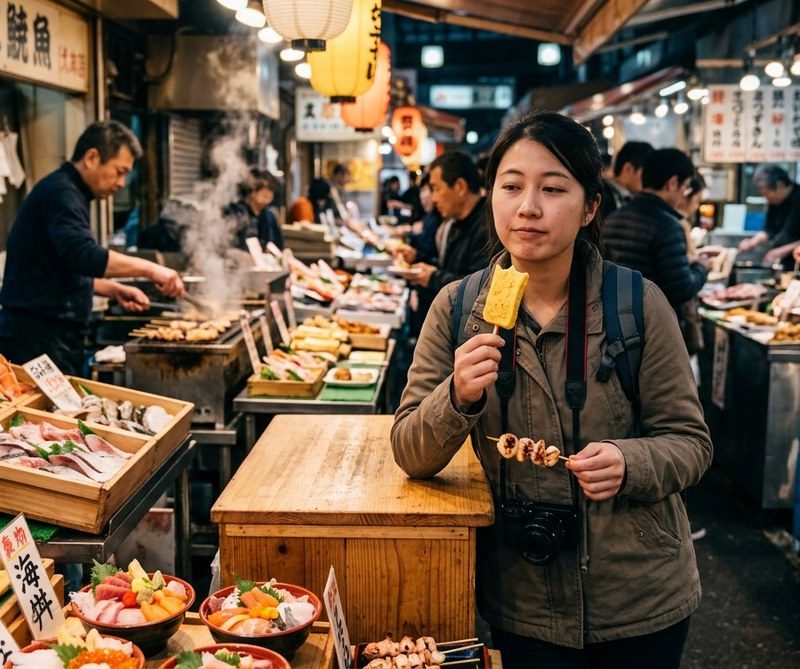
The smell of grilled seafood hits you before you even step through the gate. A vendor calls out in Japanese, waving a skewer of scallops the size of your palm. Someone next to you is slurping a bowl of steaming ramen at 7:00 AM. This is the Tsukiji Outer Market, and you have 24 hours to eat as much of it as possible.
If you are planning a trip to Tokyo in 2026, this market belongs at the top of your food itinerary. The inner wholesale market moved to Toyosu a few years back, but the outer market is still very much alive. It is a maze of narrow alleyways packed with over 400 shops, stalls, and tiny restaurants. Some have been run by the same families for three generations. Others are newer spots catering to the wave of international food lovers who arrive each morning with empty stomachs and high expectations.
This Tsukiji Outer Market food guide will walk you through everything you need to know. You will learn the best strategy for pacing yourself, the dishes you cannot miss, and the common mistakes that ruin a good food marathon.
A successful 24 hour food marathon at Tsukiji Outer Market requires strategy, not just appetite. Start early, share everything, and save room for the unexpected. Focus on grilled seafood, tamagoyaki, and fresh wasabi. Avoid filling up on rice bowls early in the day. Pace yourself with small bites and plenty of green tea.
Why Tsukiji Still Matters in 2026
Some travelers assume Tsukiji is a tourist trap now. They are wrong.
The outer market never lost its soul. Yes, you will see more foreigners than locals at certain stalls. But walk two blocks off the main drag, and you will find butchers cutting giant tuna blocks with hand forged knives, seaweed vendors weighing out bags of nori by the gram, and old men drinking coffee at counters so narrow your elbows hang off the edge.
The market has also adapted. Many stalls now accept credit cards. A few have English menus. But the heart of the experience remains the same: you eat what is fresh, you eat it standing up, and you eat it immediately.
If you want to understand how Tokyo eats, this is where you start. For a broader look at how food markets work around the world, you might enjoy reading about how to navigate a traditional night market like a local food expert.
Your 24 Hour Game Plan
A food marathon is not about eating nonstop for a full day. That is a mistake first timers make. You need a rhythm. Here is the approach that works.
- Arrive by 6:00 AM. The market wakes up early. Most food stalls open between 5:00 AM and 6:00 AM. By 7:00 AM, lines form at the famous spots. Get there before the crowd.
- Walk the entire market first. Do not buy anything for the first 20 minutes. Walk every alley. See what looks good. Note where the lines are. Make a mental map.
- Start with one savory bite. Your first stop should be something small. A skewer of grilled unagi. A single tamagoyaki. Do not order a full meal yet.
- Alternate hot and cold. After a grilled item, try something raw. Then something warm again. This keeps your palate fresh and prevents flavor fatigue.
- Drink tea between stops. Green tea is available at most stalls. It cleanses your palate and helps digestion. Skip soda and sugary drinks.
- Take a break at noon. The market gets crowded around lunchtime. Step away for an hour. Walk to a nearby park or just sit on a bench. Let your food settle.
- Return for afternoon snacks. Many stalls offer different items in the afternoon. Grilled items get swapped for fried ones. Dessert options appear.
- Finish with something sweet. End your marathon with a matcha soft serve or a bowl of anmitsu. It signals to your brain that the eating is done.
The Dishes You Cannot Skip
Not everything at Tsukiji is worth your stomach space. Some items are iconic for a reason. Others are overpriced tourist bait. Here is what you should prioritize.
Grilled Seafood Skewers
This is the backbone of the Tsukiji experience. Stalls grill scallops, shrimp, eel, and squid over charcoal right in front of you. The smell alone will pull you in.
Look for stalls where the grill master works with focus. They should be turning each skewer by hand, not letting them sit. A good scallop should have a slight char on the outside and remain translucent in the center. If it is fully opaque and rubbery, the stall rushed it.
Tamagoyaki
This Japanese rolled omelet is sold at dedicated stalls throughout the market. It is slightly sweet, layered, and served warm on a stick or a small plate.
The best tamagoyaki has a custard like texture. It should not be dry or spongy. Watch the vendor make it. If they roll it with precision and the layers are thin and even, you are in good hands.
Fresh Wasabi
You will see stalls selling whole wasabi roots. Some vendors will grate it fresh for you on a sharkskin grater. This is not the green paste from a tube. Real wasabi has a clean, herbal heat that fades quickly. It does not burn your nose for minutes.
Buy a small portion and eat it with soy sauce on a piece of sashimi. The difference is dramatic.
Kaisendon
This is a bowl of rice topped with assorted raw seafood. It sounds simple, but the quality of the fish makes it extraordinary. Look for a bowl with at least five different types of seafood. Fatty tuna, salmon roe, sea urchin, and sweet shrimp are the gold standard.
One bowl is enough for a meal. Do not order kaisendon as a snack. Save it for when you need real fuel.
Miso Soup with Clams
This is an easy one to overlook. But a good bowl of miso soup with fresh clams is deeply satisfying. The broth gets a briny richness from the clams that standard miso soup cannot match.
Order it at a stall that specializes in soup. If they are using a dashi made from real bonito flakes, you will taste the difference.
Common Mistakes and How to Avoid Them
I have watched people crash and burn at Tsukiji. They show up at 10:00 AM, order a giant bowl of rice, and tap out by noon. Do not be that person.
| Mistake | Why It Hurts | What to Do Instead |
|---|---|---|
| Eating a full meal first | Fills you up immediately, leaving no room for variety | Start with one skewer or a single tamagoyaki |
| Ignoring lines | Long lines usually mean better food and fresher ingredients | Wait 10 minutes for a stall with a line of locals |
| Paying for bottled water | Takes up stomach space and costs more than tea | Drink free green tea offered at most stalls |
| Sticking to the main street | The best food is often one alley off the main path | Walk every side street at least once |
| Ordering everything with rice | Rice is filler. It kills your appetite fast | Order items without rice unless it is a kaisendon |
| Going at peak hours | Crowds make the experience stressful and slow | Arrive at 6:00 AM or return at 2:00 PM |
Expert advice from a third generation Tsukiji vendor I spoke with: “Eat with your eyes first. If the fish does not look perfect, do not buy it. The market has 400 stalls. There is always a better piece of fish two steps away.”
How to Read a Tsukiji Menu
Most stalls have pictures, but some do not. Here are the key terms you need.
- Uni (sea urchin) — Bright orange, creamy, tastes like the ocean
- Anago (saltwater eel) — More delicate than freshwater eel, often simmered
- Hotate (scallop) — Sweet and tender when grilled properly
- Ikura (salmon roe) — Orange pearls that pop in your mouth
- Maguro (tuna) — Look for otoro (fatty belly) if you want the best
- Tamago (egg) — Usually refers to tamagoyaki at market stalls
- Soba (buckwheat noodles) — Served cold or hot, a good palate cleanser
If you want to practice reading Japanese menus before your trip, check out our guide on how to read a restaurant menu like a chef. It translates directly to the market experience.
The Hidden Gems Most Tourists Miss
The famous stalls get all the attention. But the real magic of Tsukiji is in the places that do not have Instagram famous signs.
The Knife Shop with a Tasting Counter
One shop sells hand forged kitchen knives and also offers small samples of the fish they just cut. You can watch a craftsman sharpen a blade on a water stone, then taste a sliver of tuna cut with that same knife. It is a two minute experience that connects the tool to the food.
The Pickle Stall
At the edge of the market, an elderly woman sells homemade pickles from glass jars. She lets you sample anything. The daikon radish pickled in rice bran is life changing. Buy a small bag to snack on between heavy dishes. The acidity resets your palate.
The Coffee Stand
There is a tiny coffee stand run by a man who roasts his own beans. He serves pour over coffee in ceramic cups. The coffee is bright and clean, a perfect contrast to all the seafood fat. Sit on the crate next to his cart and watch the market move around you.
For more ideas on finding off the radar food spots, read about how to create your own international food tour for a global culinary experience. The principles apply anywhere.
When to Visit for the Best Experience
Timing matters more than almost anything else at Tsukiji.
- Best time for freshness: 5:30 AM to 7:00 AM. The fish comes in overnight, and the morning rush means everything is moving fast.
- Best time for crowds: 2:00 PM to 4:00 PM. The lunch crowd is gone. The dinner crowd has not arrived. You will have space to breathe.
- Best time for dessert: 11:00 AM to noon. Matcha soft serve and sweet bean desserts appear mid morning.
- Worst time to visit: 10:00 AM to 11:30 AM. This is when tour groups arrive. The main alley gets packed shoulder to shoulder.
The market is closed on Sundays and some Wednesdays. Check the calendar before you go. Do not show up to a closed market with an empty stomach.
What to Bring and What to Leave Behind
Your backpack matters. You will be standing, walking, and eating with your hands. Pack light.
Bring:
– Cash. Many stalls are still cash only. Small bills are best.
– A reusable shopping bag. You will buy things to take home.
– Hand wipes. Things get sticky.
– A water bottle. Fill it with tea from stalls that offer it.
– Comfortable shoes. You will walk for hours on concrete.
Leave behind:
– Large suitcases. The alleys are narrow. You will block traffic.
– Expensive cameras. Keep your phone in your pocket. Be present.
– Food allergies without a translation card. If you have allergies, get a card written in Japanese. Do not assume they will understand English.
How to Handle the End of the Marathon
By hour 20, you will feel full. That is normal. The last few hours should be light.
Focus on drinks. Try a cup of warm amazake, a fermented rice drink that is slightly sweet and non alcoholic. It is gentle on the stomach and feels like a warm hug.
If you still have room, grab a piece of fruit. Japanese fruit is expensive but incredible. A single peach or a handful of grapes can be a perfect finish.
Do not force yourself to eat more than you want. The goal is not to suffer. The goal is to taste as much as possible while staying comfortable.
Your Checklist for a Successful Tsukiji Marathon
- Arrive before 6:30 AM
- Walk the entire market before buying anything
- Start with one small savory item
- Alternate between grilled and raw dishes
- Drink green tea between every two stops
- Take a break at noon
- Try something unexpected (pickles, coffee, knife shop samples)
- End with something sweet
- Leave before you feel miserable
Making the Most of Your 24 Hours
Tsukiji Outer Market is not just a place to eat. It is a living museum of Japanese food culture. The vendors have been doing this for decades. They know their fish, their knives, and their customers.
If you treat it like a checklist, you will miss the point. Slow down. Watch the grill masters work. Notice how the fish changes color as it cooks. Listen to the rhythm of the market. It has its own pulse.
The best memories from a Tsukiji food marathon are not the dishes themselves. They are the moments between bites. The old woman who hands you a free sample of pickled plum. The knife sharpener who lets you hold a blade that costs more than your flight. The vendor who sees you eyeing the sea urchin and gives you the best piece without you asking.
That is the real Tsukiji. And it is still there, waiting for you.
If you want to continue your food journey across Japan, read about how to plan a Japanese ramen pilgrimage across Tokyo’s best neighborhoods. It pairs perfectly with a Tsukiji visit.