Salt sits on nearly every kitchen counter, yet most of us reach for the same shaker without thinking. You might grab a pinch for pasta water, a sprinkle for eggs, a crust for a steak. But here is the truth: the shape and size of those crystals change how they dissolve, how they cling to food, and how they deliver flavor. Using the right type of salt for cooking can turn a good dish into a great one. And the best part? You only need a few to cover almost everything.
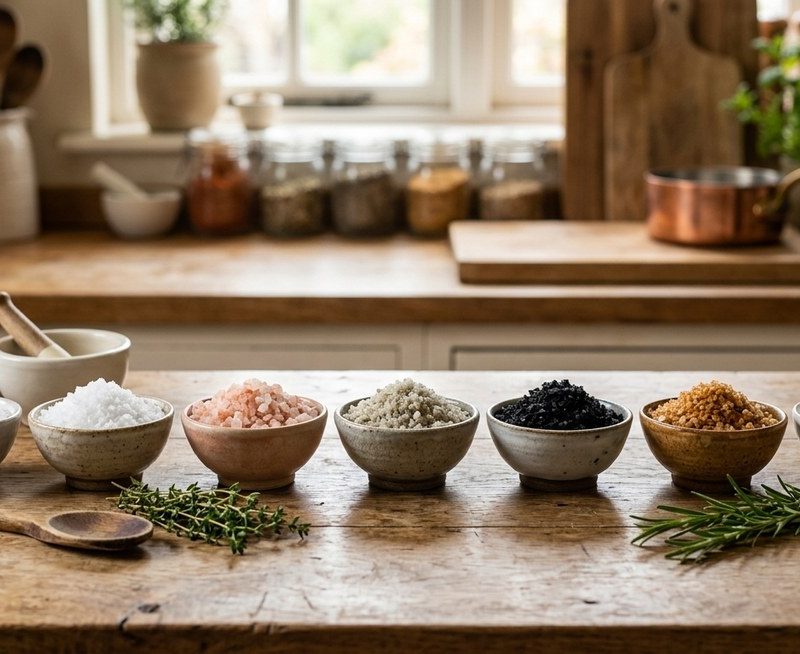
Not all salt is the same. Kosher salt is the workhorse for everyday cooking because of its easy grip and even seasoning. Table salt works best for baking. Sea salt and flake salt add crunch as finishing salts. Fleur de sel, pink Himalayan, and black salt bring unique flavors and colors. Store each in a dry place, and weigh or use volume conversions when substituting. Master these seven, and your seasoning will never be guesswork again.
Why Salt Choice Matters in the Kitchen
Salt does more than make food salty. It enhances natural flavors, balances bitterness, and changes texture. The difference between a flaky crystal and a fine grain affects how quickly it dissolves and how evenly it spreads. That matters when you season a steak right before searing, or when you bake a loaf of bread where even distribution is key.
Think of salt as the conductor of your dish. A coarse kosher salt dissolves slowly, giving you time to rub it into meat. A fine table salt dissolves almost instantly, which is perfect for dough. A delicate flake salt shatters on the tongue, adding a burst of saltiness that lingers. Choosing the wrong type can lead to overseasoning, underseasoning, or a gritty texture.
The 7 Essential Types of Salt for Cooking
You do not need a dozen jars. These seven cover every technique from brining to finishing.
1. Kosher Salt
Kosher salt is the go to for most professional cooks. Its large, irregular flakes are easy to pinch and sprinkle. The crystals are less dense than table salt, so you get a lighter hand. Because it does not contain iodine, it has a clean taste.
Use kosher salt for:
– Seasoning meats before searing or roasting
– Salting pasta water
– General cooking where you want control
Many recipes (including our own) call for kosher salt as the default. If a recipe just says “salt,” assume kosher unless stated otherwise.
2. Table Salt
Table salt is the fine, free flowing salt you find in most shakers. It often has anti caking agents and iodine added. The small crystals dissolve very fast, which makes it reliable for baking where you need even distribution.
Use table salt for:
– Baking cakes, cookies, and breads
– Recipes that specify exact measurements by volume
– Quick pickling where you want salt to dissolve immediately
Be careful when substituting table salt for kosher. Because the crystals are smaller, 1 teaspoon of table salt equals about 1.5 teaspoons of kosher salt by weight. Always check your recipe.
3. Sea Salt
Sea salt comes from evaporated seawater. It can be fine, coarse, or flaky depending on how it is processed. Unrefined sea salt retains trace minerals that can give subtle differences in flavor. For everyday cooking, a fine sea salt works well as a substitute for table salt without iodine.
Use sea salt for:
– Everyday seasoning when you prefer a natural product
– Bathing vegetables before roasting
– Making finishing salts (just flake the coarse variety)
Store sea salt in a dry container. Humidity can cause clumping.
4. Flake Salt
Flake salt has thin, flat crystals that look like tiny pyramids or snowflakes. They are fragile and brittle. When you sprinkle them on a finished dish, they shatter and release a burst of saltiness. They also add visual appeal.
Use flake salt for:
– Finishing roasted vegetables, grilled fish, or salads
– Topping chocolate chip cookies right before baking
– Adding a salty crunch to caramel or toffee
Popular brands include Maldon and Jacobsen. Keep them away from steam to preserve the delicate flakes.
5. Fleur de Sel
Fleur de sel is a hand harvested sea salt from France. It forms as a thin crust on the surface of salt ponds. The crystals are moist, delicate, and have a higher mineral content. This is a luxury finishing salt, not for cooking.
Use fleur de sel for:
– Sprinkling over a perfectly seared steak
– Topping fresh tomatoes with cheese
– Garnishing foie gras or high quality butter
Because it is expensive and moist, use it sparingly and only at the end. Never cook with it.
6. Pink Himalayan Salt
Pink Himalayan salt is mined from ancient sea beds in Pakistan. Its pink color comes from trace minerals like iron. The crystals are large and hard. Many home cooks use it in salt grinders or for salt blocks used for grilling or serving.
Use pink Himalayan salt for:
– Grinding fresh over dishes just before serving
– Cooking on salt blocks (great for searing shrimp or veggies)
– Adding a subtle mineral taste and beautiful color
Note that the mineral content does not significantly affect flavor. It is more about texture and appearance.
7. Black Salt (Kala Namak)
Black salt, or kala namak, is a volcanic rock salt from India. It has a distinctive sulfurous smell because of iron sulfide. When ground, it looks pinkish gray. The flavor is earthy and reminiscent of hard boiled eggs.
Use black salt for:
– Vegan dishes to mimic egg flavor (tofu scramble, egg salad)
– Asian salads and chutneys
– Finishing South Indian street food
Because the aroma is strong, use it sparingly. It pairs well with tangy ingredients like lemon or tamarind.
Comparing Salts at a Glance
| Salt Type | Grain Size | Best For | Substitution Rule |
|---|---|---|---|
| Kosher | Coarse, flaky | General cooking, meat | 1 tsp table = 1.5 tsp kosher |
| Table | Fine | Baking, quick dissolving | 1 tsp table = 1 tsp (use weight for precision) |
| Sea Salt (fine) | Fine to medium | All purpose, natural | Same as table salt by volume |
| Flake Salt | Thin, fragile | Finishing | Not for cooking; use 2x volume vs table |
| Fleur de Sel | Moist, delicate | Finishing only | Not interchangeable |
| Pink Himalayan | Coarse | Grinding, salt blocks | Grind to match table size; 1:1 by weight |
| Black Salt | Coarse or ground | Finishing, vegan eggs | Use by taste, not volume |
How to Choose and Substitute Salts in Recipes
Many home cooks wonder if they can swap one salt for another. The answer is yes, but you need to adjust. Here is a numbered system to make it easy.
-
Identify the role. Is the salt for seasoning during cooking, for baking, or for finishing? Cooking and finishing salts are not interchangeable because of texture.
-
Check the recipe’s default. If the recipe says “salt” without specifying, assume kosher. If it says “fine salt,” use table or fine sea salt.
-
Convert by weight, not volume. Salt densities vary wildly. A cup of table salt weighs much more than a cup of flake salt. Use a kitchen scale for best results. For example, 1 teaspoon of kosher salt weighs about 3 grams, while 1 teaspoon of table salt weighs about 5.7 grams.
-
Taste as you go. When substituting a finishing salt for cooking salt, add it at the end and taste. You will likely need less.
-
Store each salt correctly. Keep all salts in airtight containers away from moisture and heat. Do not store salt near the stove where steam rises.
If you are new to salt types, start with kosher salt for cooking and a flake salt for finishing. Add more varieties as you experiment. For more kitchen terminology, check out our guide on 15 misunderstood cooking terms that will clear up any confusion.
Common Salt Mistakes and How to Avoid Them
Even experienced cooks make these errors. Here is what to watch for.
- Using table salt in a recipe that expects kosher. You will end up with an overly salty dish. Always check the grain size.
- Salting too early for vegetables. Salt draws out moisture. For crispy roasted potatoes, salt after parboiling, not before. For cucumber salad, salt early to remove bitterness.
- Storing finishing salts in a shaker. Flake salt and fleur de sel break down into dust. Keep them in a small bowl with a lid, and use your fingers.
- Assuming all sea salts are the same. Coarse sea salt needs more time to dissolve than fine sea salt. Adjust accordingly.
- Ignoring the iodine in table salt. Iodized table salt can give a slight metallic taste. Use non iodized for sensitive recipes like buttery sauces.
Expert advice: “If you want to improve your seasoning instantly, ditch the table salt for cooking and switch to kosher. You will get better control and a cleaner flavor. Keep table salt only for baking where precision matters.” — Chef Maria Flores, author of The Saltwise Kitchen
Bringing the Right Salt into Your Daily Cooking
You do not need a big collection. Start with two or three types that match how you cook. If you roast chicken or sear steaks weekly, kosher salt is nonnegotiable. If you bake often, keep table salt on hand. And if you love a crunchy finish, one flake salt will transform simple dishes.
The real secret is not having more salts. It is knowing which one to use and when. Once you understand how salt behaves, you will season with confidence. Your soups will taste brighter. Your meats will be perfectly seasoned all the way through. Your cookies will have the right snap.
So next time you reach for that shaker, pause. Look at the crystal size. Think about the dish. Pick the right tool for the job. That small habit will make a big difference in every meal you cook.